


The halal sector
Catalonia concentrates one of the main agri-food sectors in Europe, and orients its supply to the demand of different consumer and market segments. In the Halal section, it is positioned as a leader in Spain in food and drinks certified with this seal of guarantee.
A market of more than 1.5 billion euros
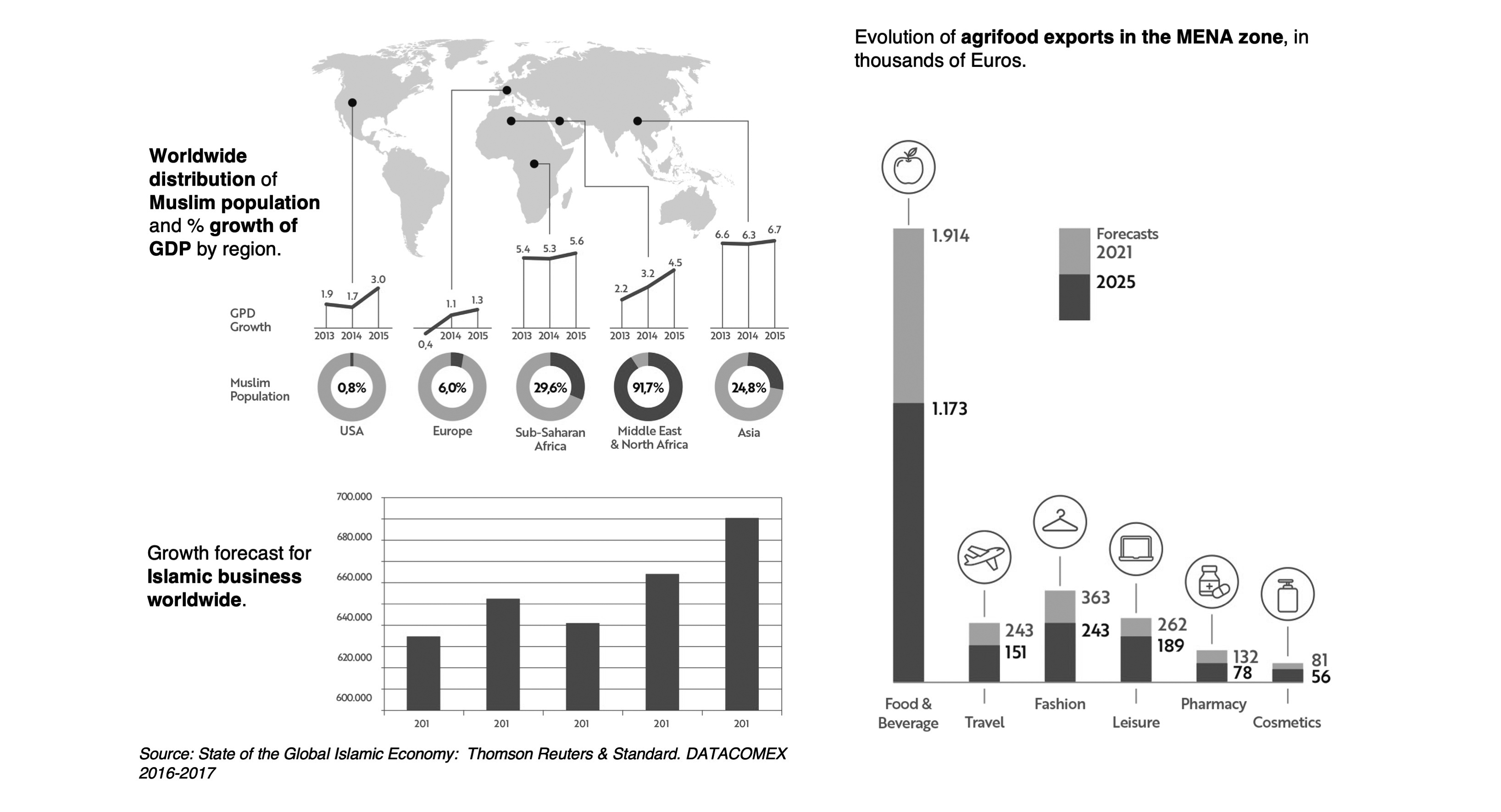
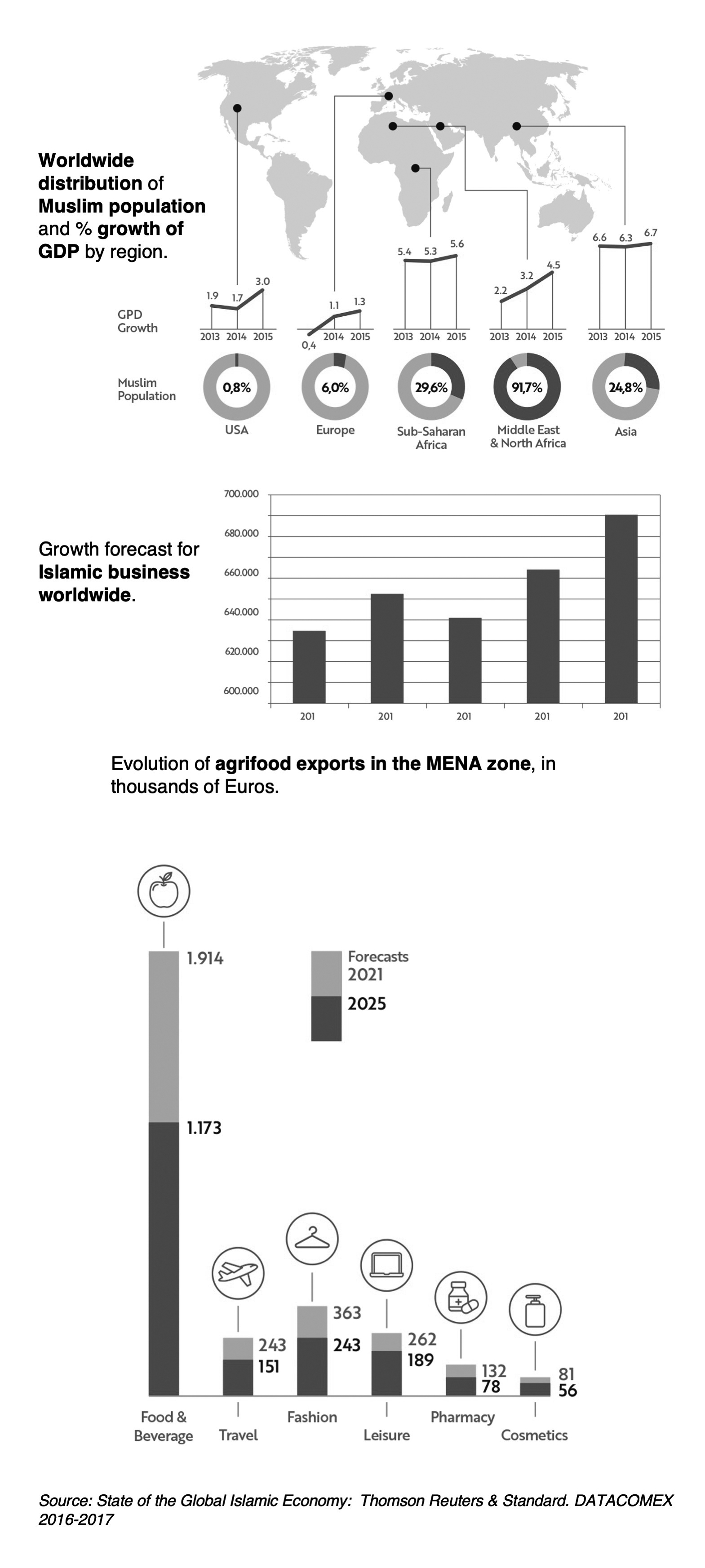
The global Halal food and beverage market stood at €1.55 trillion in 2020, and is expected to grow at a compound annual growth rate (CAGR) of 6.6% over the period 2020-2025.
It has emerged as a new growth sector of the world economy, with a strong presence in developed countries. The markets with the most projection are the fast-growing economies of Asia-Pacific, the Middle East, Europe and America.
Until the last decade, there was significant demand for Halal food from countries such as Indonesia, Malaysia, Saudi Arabia, Singapore and the United Arab Emirates. However, this market segment has increased demand in countries such as the United States, Germany, Australia and India due to the preference of consumers, both Muslim and non-Muslim, for Halal food and beverages.
This food option goes beyond the Muslim consumer, as Halal-certified food is increasingly perceived as more controlled and more transparent, and as a guarantee of safety, hygiene and reliability, in parallel with the growing interest in consumption of organic and natural foods and drinks, which add to this trend.
The forecast that the offer of Halal food and beverages in stores, supermarkets and hypermarkets will increase due to the demand of Muslim and non-Muslim consumers, both internationally and in Europe, will contribute to the growth forecasts of this segment in the next years At the same time, the adoption of different marketing strategies, such as product innovation, and the expansion and customization of the product line, with the standardization of tastes, makes it possible to have a more diverse offer available to consumers.
New European trend
The exponential growth of the European Muslim population in recent years and the increase in purchasing power has led to the emergence of a new segment of the urban population, fully integrated, which wants to maintain traditional practices without renouncing sophistication.
As the Muslim world changes and globalization trends continue to shape consumer tastes, habits and spending patterns worldwide, the growth of Halal food and beverages is expected to increase market share in Europe and integrate into spending patterns associated no longer with a religious component, but with an interest in safe and healthy food.
The European halal food and beverage market is still highly fragmented, with major manufacturers focusing on expanding presence and product development, as well as engaging in partnerships, mergers and acquisitions to meet growing consumer needs.
United States, Halal health
Concern for the health and nutrition of non-Muslim Americans promotes the Halal food and beverage market, which is based on the idea of hygiene and freshness. At the same time, the government imposes strict rules and regulations to regulate the Halal industry and prevent fraudulent practices.
Asia-Pacific: the fastest growing market
The Asia-Pacific region has the largest number of Muslim population, and the Halal food and beverage market in the region is expected to register a compound annual growth rate (CAGR) of 5.5% during the period 2020 – 2025 .
The migration of people from areas of Muslim tradition to other regions is part of the dynamic that favors a significant increase in the Muslim population in Asia-Pacific and, consequently, also increases the demand for Halal food and drinks. It is expected that this trend will continue in the coming years, and that it will drive the development of the sector with the inclusion of the auxiliary industries of storage, handling, transport and delivery.
A growing potential market
In 2010, there were 1.6 billion Muslims all over the globe, representing 23% of the world's population. Islam is the second-largest religion in the world.
The Muslim population is expected to increase to around 2.8 billion by 2050, which would amount to 30% of the world's population. A full 62% of the Muslim population is concentrated in the Asia-Pacific region. The proportion of Muslims is expected to fall in countries such as Indonesia, India and Pakistan. This would put the region’s share of the world total at 53% by 2050. The Middle East & North Africa region (MENA) is predominantly Muslim and is predicted to remain stable at 20% of the world's population in 2050.
NEWS FROM SECTOR HALAL

11.27.20
The Catalan food companies, at the online edition of the Foodex Saudi 2020 with Prodeca
10 Catalan food companies have participated with Prodeca in the Top Food Suppliers from Catalonia, Spain webinar organized during the online edition of the Foodex Saudi. The webinar was attended by 40 professionals from the import, distribution, retail and Horeca industry from Saudi Arabia.

11.23.20
Tendències del consumidor musulmà a Europa
In recent years, identity (cultural and religious) is emerging as an important factor in certain consumer decisions. The high development of the Muslim friendly segment, both in Europe and globally, it must be context in this trend.

05.01.20
Strategic plan to boost competitiveness in halal-producing companies
This initiative addresses the need for promotion and internationalisation among Catalan agri-food companies that produce for the halal market, and was presented at Alimentaria 2018.