


07.06.26
Interview with Amit Lohani (FIFI): "India's market is an opportunity for Catalan fruit exporters"
On 12 April, Prodeca, commissioned by the Afrucat association and in collaboration with Acció, began a round of B2B meetings between Catalan fruit sector companies and Indian distributors and large-retail managers. During these business meetings, held online, the Catalan companies had the chance to present their products and the potential of the Catalan agrifood sector. Around 40 bilateral meetings between Catalan producers and Indian importers are planned under this initiative.
To present the characteristics of the Indian agrifood market and bring its opportunities closer to Catalan fruit producers, on 15 April the companies taking part in Prodeca's initiative were able to attend a talk by Amit Lohani, founder and director of FIFI, Forum of Indian Food Importers.
This week we began the 1st round of B2B meetings between Catalan fruit companies from @Afrucat and distributors and importers from 🇮🇳
— Prodeca (@prodeCAT) April 15, 2021
Today Amit Lohani, president of FIFI (Forum of Indian Food Importers), presented the Indian market's opportunities for Catalan companies pic.twitter.com/8nzeMSaifv
- Mr Lohani, what is your association's profile? How can FIFI help agrifood companies internationalise?
The Forum of Indian Food Importers (FIFI) is a non-governmental, non-profit body working mainly to improve the food and beverage business in India, above all through outreach activities. Since its founding in 2009, FIFI has led a strategy focused on highlighting the agrifood industry's perspective on various fronts. The association fosters meaningful exchange of information and knowledge among its members and regularly connects them with government bodies, chambers, industry associations, organisations, public interest groups, think tanks, media, etc.
- Let's talk about the fruit market: what are the characteristics of this segment in India?
If we had to define the fresh fruit market in India we could do so through, for example, high production, seasonality, limited supply chain tools, growing demand, limited added value and off-season imports.
- Which fruits are most valued and consumed?
Fresh fruits are staples for maintaining a healthy diet and are geared to consumption trends: mango, banana, pomegranate, peach, grapes and apples are some of the fruits dominating India's fruit basket. Some Indian fruits have also gained ground internationally, such as grapes, which can already be seen on retail shelves in the European Union and the United Kingdom.
Interestingly, as a result of the pandemic-driven economic shutdown we are seeing a trend towards local consumption of those early Indian fruits that were previously exported abroad. Some brands have in fact accelerated their domestic market entry strategy for these products.
- What fruit production needs does India have?
India has a gap in the supply of many seasonal fruits, such as the apples mentioned earlier. Most apples are grown in the hills, so the country's western and southern regions had limited access. With international products available, consumption trends have changed dramatically. In recent years India imported apples worth some 250 million dollars, with the United States and Chile as key suppliers. Cherries and berries have also become established as a consumption trend, with significant growth despite starting from a very small base.
- And what does the Indian consumer value most?
Various surveys indicate that Indians have been consuming less than the recommended daily amount of fresh fruit, although consumption patterns are evolving, attributable to the pandemic. Indeed, at a time when the social determinants of health are changing, the fruit sector is leading the new consumption dynamics. Purchasing decisions, however, depend on several factors such as socioeconomic status, education, food insecurity, geography and access.
- We are talking about a market of more than a billion consumers: are there regional differences?
India has an even spread of fruit production, strongly shaped by regional dietary habits. However, with other products available, India has shown shifts in consumption, such as southern Indian consumers who previously had limited access to fresh apples and now have access all year round. Today the main importers have a presence in India and can achieve regional market penetration depending on season and demand.
- How would you rate the Indian market for companies from outside the country wanting to sell there? Do you think it is an accessible market for foreign companies?
Trade figures clearly show the supply-demand gap mentioned earlier, which was not based only on low production: factors such as seasonality, geography and international trends also play a crucial role. Within the agrifood sector, India's exports are more diverse than its imports, and fresh fruit is no exception. India is a fast-growing market for fresh fruit from various countries, but it remains a difficult market to navigate, with high tariffs, an evolving regulatory environment and competition from other supplier countries alongside domestic production.
Even so, India is a potentially diverse market that can be an advantageous buyer for suppliers if they approach it the right way. Indian buyers tend to seek partnerships with brands or companies willing to commit to India's story, grow with their partners, consolidate the relationship, meet India's regulatory requirements and evolve with changing commercial prospects.
- What should foreign companies bear in mind when importing into India? Are there specific requirements for fruit sector companies to consider before exporting?
Any company must first determine whether its product range has market access in India. Bear in mind that the fresh fruit sector is subject to plant quarantine regulations. It is always advisable to work with the country's trade office, as they can update prospective suppliers on current regulations. Import tariffs on fresh products can range from 0 to 100% and some products may also carry specific taxes.
Once a company is aware of the regulatory requirements and the tariff structure, it should consider finding a reliable commercial partner in the country with the capacity to achieve penetration of the Indian market. It is also advisable to secure payment terms until a good working relationship is established.
- Studies show an increase in fruit consumption in India over the next five years. Will this also mean an increase in imports?
Yes, demand is expected to grow thanks to changing lifestyles, seasonal availability, dual-income households, rapid urbanisation, digitalisation, conscious consumption, the premium on international products and most imports being attributed to health benefits. These changing trends are expected to lead both to increased production in India and to the arrival of international goods. These estimates, however, assume other factors remain constant, such as the revival of international trade flows, the slowing of the global pandemic, economic recoveries and others.
- Which fruits do you think will be most in demand in the immediate future?
At present there is more demand for superfoods or those credited with an additional health factor. Blueberries, red berries and cherries seem to be the fruits of the new era with the greatest demand, while apples, bananas, peaches, pears, grapes and others will remain a constant in the fruit basket.
- Finally, how do you think Catalan companies can take advantage of this context to play a significant role in the Indian market?
Yes, India's market is an opportunity for Catalan exporters. The country is hungry for fruit, including the kinds grown in Catalonia such as peaches, nectarines, pears and apples. Catalan companies should focus more on product and brand placement. Efforts could include taking part in trade fairs such as AAHAR, engaging with a local influencer or mapping agricultural tourism with India. Immunity-boosting products such as fresh fruit are one of the top purchasing priorities for Indian consumers, and Indian companies reflect this in their new buying decisions.
This is undoubtedly an opportune moment for domestic and international companies to see the opportunity and benefit India represents, while ensuring Indian consumers have access to quality products from around the world.

02.05.21
Prodeca and Afrucat bring Catalan producers closer to the Indian market
Prodeca, with the collaboration of ACCIÓ and on behalf of the sectorial association AFRUCAT, organizes a business meeting with importers, distributors and managers of large stores in India.
12.09.19
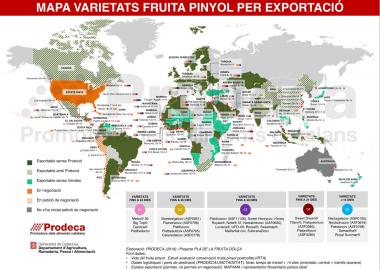
Prodeca publishes new map to meet sector needs to export stone fruit worldwide
Prodeca has produced a new map of world countries which sets out protocols to export stone fruit according to each local situation.