
07.06.26
The Catalan agri-food sector saves nearly €70M in tariffs due to the Brexit agreement
Consult all the updated information on Brexit and its impact on the agri-food sector at prodecabrexit.cat
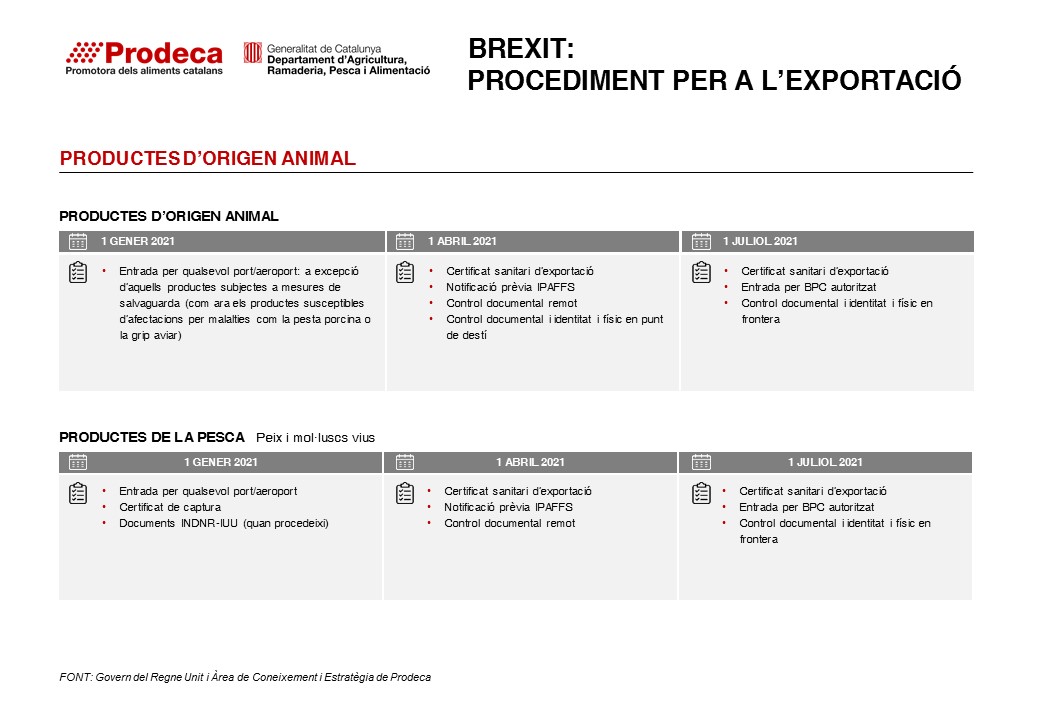
After months of negotiations, the United Kingdom and the European Union have been able to resolve their differences and last Thursday, December 24, they reached a provisional agreement on Brexit. The first and most important consequence of the agreement is that the Catalan agri-food sector will save an additional cost in tariffs calculated at 69.34 million euros. In this way, sectors such as meat and Fine Food, two of the potentially most affected, breathe easy. In fact, it is expected that Catalan food exports to the United Kingdom may increase by around 9% in 2021.
Another consequence that the Catalan exporting companies will not ultimately suffer, once the agreement is ratified, is the appearance of new competing countries with more favorable trading conditions, since the agreement prevents us from entering the framework of the WTO. Likewise, the Catalan food sector should also compare with unfavorable conditions with other countries that have shielded their bilateral relations with the United Kingdom, such as the USA, Canada, Chile, Japan, Israel or Morocco, among others.
The United Kingdom, a major market for Catalan food exports
Food is the fourth most important sector of Catalan exports to the United Kingdom with a 12.71% of the total exported with €548.70M exported in 2019 (5.14% of the total exported to the world). It should be noted that, in the last 10 years Catalan agri-food exports to the United Kingdom have grown by 66.49% in volume and doubled in value (103.18%). Currently, it is the sixth destination country for food and drink exports from Catalonia, behind France, Italy, China, Germany and Portugal. However, Catalonia is the United Kingdom's 19th global supplier of food and 11th among the EU member countries.
The agri-food market in the United Kingdom is very mature, with a very varied offer and strong competition, but on the other hand it facilitates the entry and consolidation of companies that make quality and added value products. In this sense, it has become a very attractive market for Catalan companies who have seen how their products are well valued by British consumers. A fact that confirms this is that, during 2020 and with respect to 2019, with the data available until September, agri-food exports to the United Kingdom have increased by 3.03% in value and 3.65% in volume.
On the other hand, 3,382 Catalan companies (2019) export to the United Kingdom, of which 557 correspond to food and beverage companies (16.47%).
The Catalan agri-food sectors that export the most to the United Kingdom are Fine Food (35.61%) of the total exported - led by canned fruit and vegetables (8.23%), pastry products (7.02%), prepared dishes (6.11%), beer (4.43%), cocoa and cocoa products (2.44%), coffee (2.15%), confectionery (2.03%) and nuts (1.82%) -, meat (31.24%), fruit and vegetables (10.96%), wine (8.56%), vegetable oils (5.10%) - led by olive oil (3.96%) - and fish (1.63%).

It should also be noted that the The UK is a net food importing country, since its productions are not sufficient to feed its population and it imports more than 50% of the food it consumes.
Only 15% of fresh fruit and 55% of vegetables sold in the UK are grown locally and the majority comes from the EU. Thus, it is a net importer of fruit and vegetables. On the other hand, close to 40% of the pork consumed in the British market comes from imports.
01.02.20
The impact of Brexit on Catalan agri-food exports
31 January 2020. A definitive date for Brexit has now been set. Boris Johnson's absolute majority has ratified the Prime Minister's plan for the United Kingdom to move decidedly towards leaving the European Union. However, although we now know when Brexit will happen, a lot has yet to be resolved, especially for export companies.

10.23.19
Trump's tariffs - working together for Catalan food
On 18 October, the Trump administration's new tariff hikes on European agri-food products will take effect.