


The foodservice sector in Catalonia

Descarrega el document

El sector del foodservice a Catalunya
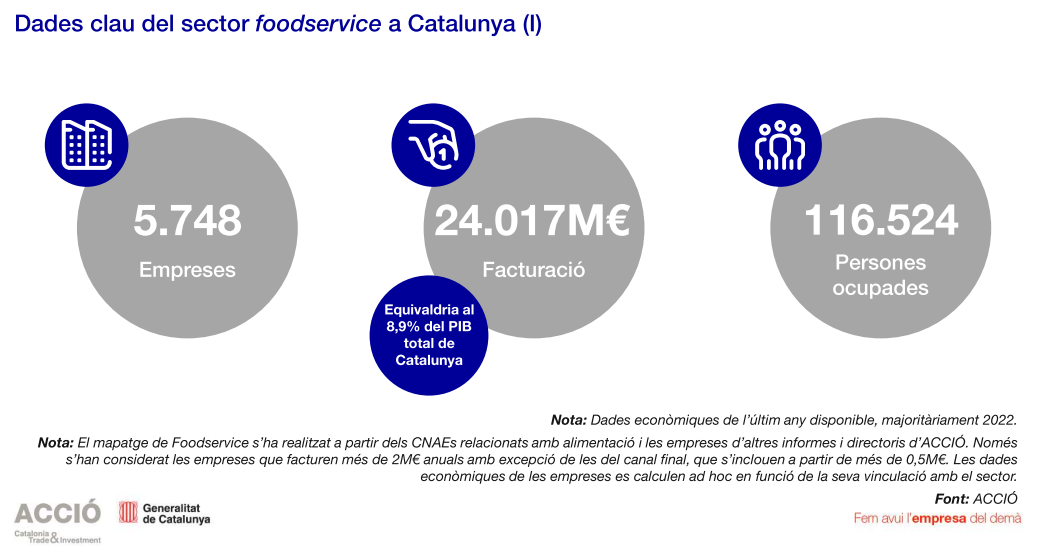
The foodservice sector in Catalonia is one of the most dynamic and important parts of the Catalan economy. It currently has a turnover of more than €24 billion a year, equivalent to 8.9% of Catalan GDP. It also comprises 5,748 companies and employs some 116,524 people. Of these companies, 51% deal directly with the end customer, providing food and drink services at venues such as restaurants, schools, hospitals and other immediate-consumption settings.
In terms of composition, almost half the turnover comes from the food and drink processing industry, accounting for 49% of total revenue, while distribution represents 24%. Notably, 95% of the sector's companies are Catalan, and most have more than 10 years' experience, demonstrating the sector's stability.
Demand and trends
Globally, the foodservice sector has seen a profound shift in consumer demands and preferences, with a strong orientation towards sustainability, healthy eating and commitment to the local area. The outlook for the coming years points to continued growth, driven especially by digitalisation and sustainability. The adoption of technologies such as artificial intelligence and automation in order management and logistics are key factors. Moreover, digitalisation is expected to enable better connections with consumers via social media and online platforms.
Some of the main global trends in this market are:
- Sustainable, local food: consumers are increasingly interested in where their food comes from and choose products with clear traceability, favouring zero-kilometre and organic foods. These preferences drive demand for local products, leading many restaurant chains and food services to adopt a responsible purchasing philosophy aligned with reducing their ecological footprint.
- Plant-based foods and flexitarian diets: a growing number of consumers worldwide are adopting vegetarian, vegan or flexitarian diets. This has driven innovation in meat substitutes, with products such as vegetable or artichoke burgers and other plant-based ingredients. This shift chimes with concerns about livestock farming's environmental impact and the potential health benefits of eating less animal protein.
- Reducing food waste: tackling waste is another prominent global trend. In many countries, companies and organisations have introduced technologies and policies to minimise the amount of food wasted. The creative use of leftovers or under-used ingredients, such as the panettone croquettes presented at Gastronomic Forum 2023, reflects this move towards reducing waste.
- Digitalisation and new technologies: digitalisation in foodservice accelerated with the pandemic and remains a key trend. This includes online ordering, contactless payments and using artificial intelligence to personalise experiences or optimise supply chains. This trend is closely linked to the rise of delivery and home services, which have also changed how food is consumed.
- Precision cooking, including techniques such as 3D food printing: this is becoming a tool for creating more precise, consistent and personalised dishes. It is used in both haute cuisine and fast food to offer new textures and previously unexplored flavours. Technologies such as blockchain are also being introduced to ensure complete ingredient traceability, giving consumers detailed information about food origin and quality.
- Innovation in craft drinks: the growth of craft drinks, such as beers, is also booming. This movement ties in with consumers' search for originality and authenticity, as they increasingly want unique, personalised options.
Outlook for 2025
The foodservice sector will continue to focus on:
- Sustainability and environmental responsibility: reducing waste and using resources efficiently.
- Innovation in plant-based foods: the trend towards vegan, vegetarian and flexitarian diets will not slow, and the alternative protein industry is expected to diversify further with new technologies such as fermentation and cultivated meat. The range of products for consumers seeking healthy, sustainable, low-impact foods will also become established.
- Digitalisation and automation: with the expansion of online ordering and payment systems, apps for personalising menus and orders, and the use of artificial intelligence to manage the supply chain. Robots and other forms of automation could become more common in food preparation and delivery, especially in high-volume outlets. This also translates into a more interactive, efficient consumer experience, as personalisation and speed are expected to be decisive factors for customers.
- Rising demand for delivery and "ghost kitchens": consumers want convenience and speed. "Ghost kitchens" will establish themselves as a viable model, focusing exclusively on home delivery without the need for physical customer spaces, cutting operating costs for many businesses.
- Social commitment: encouraging the inclusion of local producers and small businesses in the supply chain, boosting local economies.
- A focus on health and wellbeing: consumers will continue to place ever greater value on healthy food, with growing demand for options low in sugar, sodium and fat. The range of superfoods and health-benefit ingredients, such as probiotics and functional foods, will become one of the major future trends.
This article is based on the report "The foodservice sector in Catalonia" produced by ACCIÓ and the Catalonia Foodservice Cluster.

10.29.24
Catalonia World Region of Gastronomy at Gastronomic Forum Barcelona
100 Catalan companies and organisations are taking part alongside Prodeca, the Barcelona Provincial Council's Xarxa de Productes de la Terra, Lleida Provincial Council and Girona Excel·lent in Catalonia's leading trade event for hospitality
03.19.24
The agri-food sector now accounts for 20% of Catalan GDP
According to ACCIÓ and Prodeca data, it is Catalan industry's leading sector, with aggregate turnover of more than €48 billion and over 175,000 jobs