


03.19.24
The agri-food sector now accounts for 20% of Catalan GDP
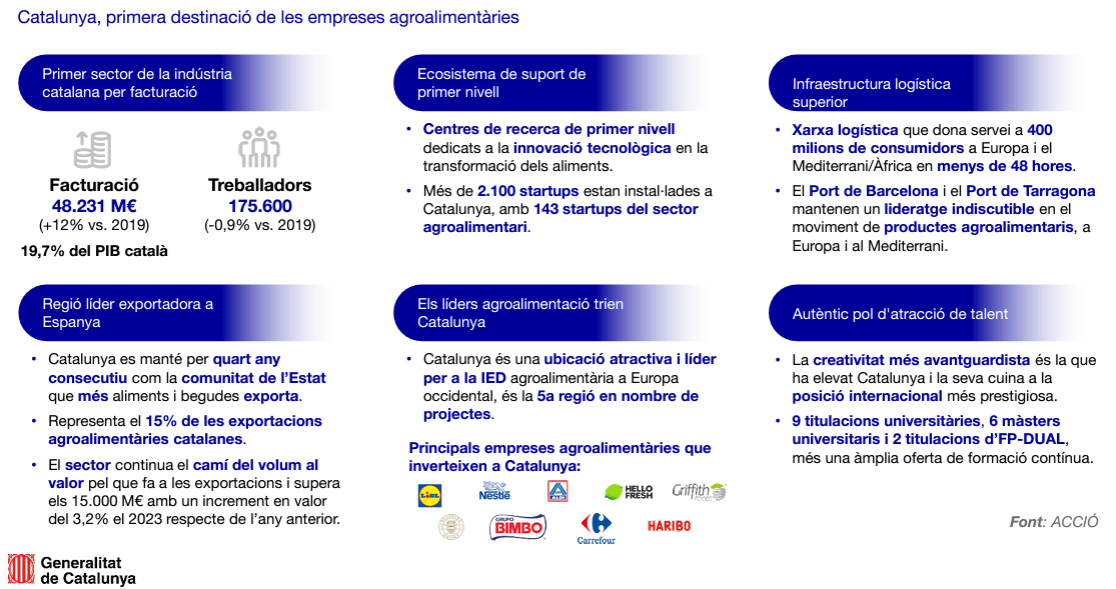
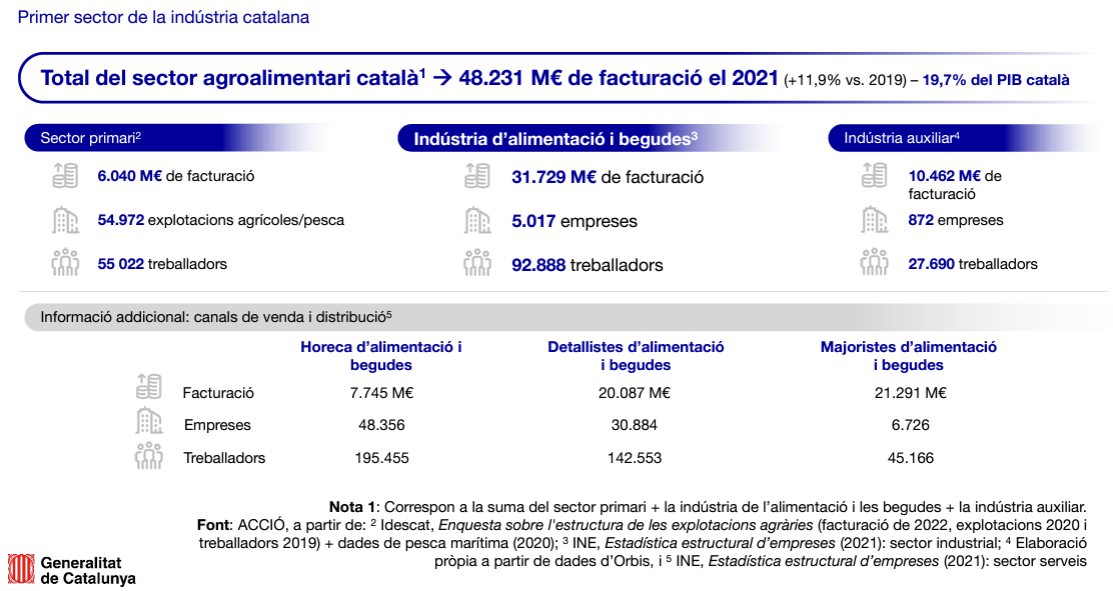
The agri-food sector now accounts for 20% of GDP (19.7% to be precise) and consolidates its position as the most important part of Catalan industry by turnover and employment. Taken as a whole, the agri-food sector generates aggregate turnover of €48.231 billion and employs 175,600 people. The Minister for Business and Labour, Roger Torrent i Ramió, announced this on Tuesday at the Alimentaria fair, where he presented some of the headline figures from the update of the study 'The agri-food sector in Catalonia', produced by ACCIÓ — the business competitiveness agency of the Department of Business and Labour — and Prodeca, the public company promoting Catalan food, part of the Department of Climate Action, Food and Rural Agenda.
Catalonia's agri-food sector comprises three broad areas. First, the almost 55,000 farming, livestock and fishing operations of the primary sector, generating €6.04 billion in turnover and employing more than 55,000 people. Second, the bulk of the sector lies in the food and drink industry, made up of 5,017 companies accounting for more than €31.7 billion in sales and employing some 93,000 people. Finally, the agri-food sector is completed by the ancillary industry directly linked to it, with 872 companies generating more than €10.4 billion and employing close to 28,000 workers.
As for the sector's main segments, the study highlights the great diversity of agri-food products originating in Catalonia. Within the food industry, those with the greatest weight in Catalan turnover are the meat industries (32% of the total), followed by animal feed products (17%), sugar, chocolate, coffee and confectionery (8%) and oils (7%).
Within this great diversity of Catalan agri-food products, the study highlights some of its elements and their territorial distribution. For example, the importance of the foodservice and food retail verticals. But also a well-established, diversified meat industry with turnover of more than €10 billion; the potential in wine and cava production, with 12 designations of origin and almost 7,000 registered winegrowers (2022 data); and olive oil production, with five designations of origin concentrated mainly in the Tarragona and Terres de l'Ebre regions.
Finally, the report highlights alternative protein as an emerging field, which already has more than 100 companies and turnover of over €250 million. This new trend, which aims to reduce animal protein consumption, is the focus of ACCIÓ's Catalonia Pavilion at Alimentaria, with 10 Catalan companies specialising in plant-based production exhibiting.
An export powerhouse
Another aspect the study addresses is the sector's export potential. In fact, Catalonia remains, for the fourth year running, Spain's leading agri-food exporting territory (22% of the total), ahead of Andalusia. In 2023 Catalonia exported €15.327 billion worth of agri-food products (15% of all Catalan exports) and has a base of more than 3,000 regular exporters in this field.
Meat and cured meats (35% of the total) are the Catalan product with the highest overseas sales, followed by fine food/multiproduct (31%), fruit and vegetables (9%), vegetable oils (8%) and wines (4%).
Catalonia, a leading international destination for foreign agri-food investment
Catalonia's potential in the agri-food sector attracts significant foreign direct investment , with the market's leading global players present in Catalonia. Between 2019 and 2023, 41 foreign investment projects brought in €697.6 million (5% more than in the previous five-year period).
Over the same 2019-2023 period, Catalonia ranked fifth in the European Union by number of foreign investment projects and attracted 3.3% of capital investment and 3.1% of the jobs created on the continent. Over the past five years international companies such as Lidl, Nestlé, Aldi, Haribo and Bimbo have invested in Catalonia.
Beyond the richness and diversity of the agri-food sector, the study also points to logistics strength as one of the main reasons for Catalonia's international appeal in this sector, where the ports of Barcelona and Tarragona play a key role, as well as having a first-rate support ecosystem. It notes the importance of hosting international fairs such as Alimentaria, the presence of more than 140 agritech and foodtech startups, and top-level agri-food and gastronomy research centres such as IRTA.
Trends and future challenges
Finally, the study sets out the sector's main global trends and its most immediate future challenges. Along these lines, sustainability and climate change adaptation emerge as essential, along with growing interest in healthy eating and the application of new technologies in so-called 'Food Service 4.0'. It also notes that agri-food technologies will drive new foods and bring Industry 4.0 technologies into their production.

02.19.24
Catalonia consolidates the shift from volume to value in agri-food exports and tops €15 billion for the first time
Agri-food exports set a new record with €15,327.60 million exported, and the sector remains a driver of the Catalan economy. Over the last 10 years, Catalan overseas agri-food sales have grown 89.95% in value and 16.15% in volume.
