Business opportunities in Peru's growing olive oil market

09.17.24
Everything you need to know to export agri-food products to Peru
A course designed to give a clear understanding of the legal, cultural and logistical requirements for successfully starting to do business in Peru, a highly diverse market with great potential for agri-food products.
This report offers an analysis of Peru's olive oil industry, with the aim of identifying business opportunities for Catalan companies in that market. It begins with an overview of the country and a detailed profile of the agri-food sector. It then examines consumption trends and the trade balance, with particular emphasis on trade relations between Catalonia and Peru. It also sets out the various channels available for marketing this type of product in the Peruvian market, barriers to market entry and the industry's key players. It also includes information useful for companies preparing to pursue business opportunities, such as the country's business culture and various relevant promotional activities.
The Peruvian market has high growth potential, both because of rising demand and because of macroeconomic strength that was not lost to the pandemic. It is also a country that is widely open to the outside world, with free trade agreements and treaties that facilitate selling there.
Olive oil trade between Peru and Spain is marked by a complementary relationship. Despite its domestic production, Peru still imports a considerable amount of olive oil, mainly from Spain. Spain remains the world's leading olive oil producer and exporter, offering a range of olive oils of different qualities and prices, which allows it to meet growing Peruvian demand.
The Peruvian food culture and the development of new consumption venues (shopping centres, supermarket chains, etc.) point to a growing consumption environment for this type of product.
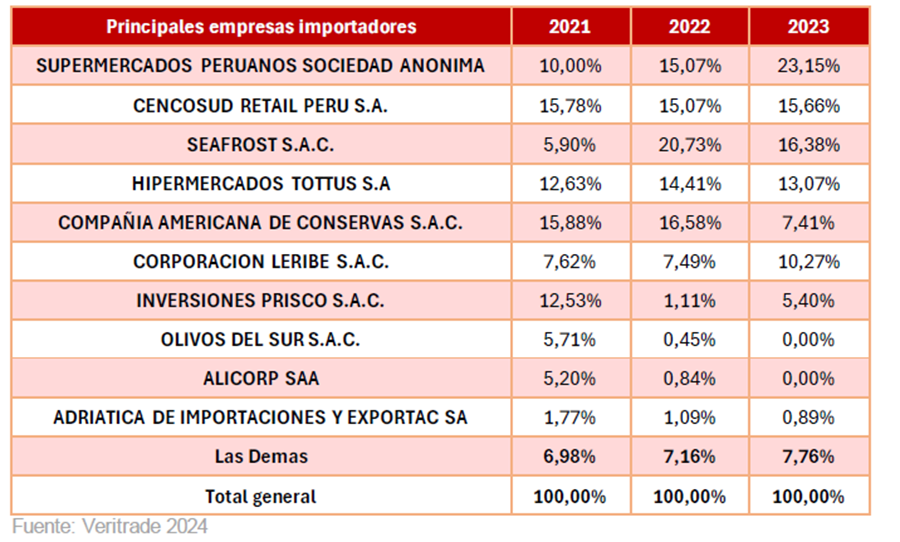
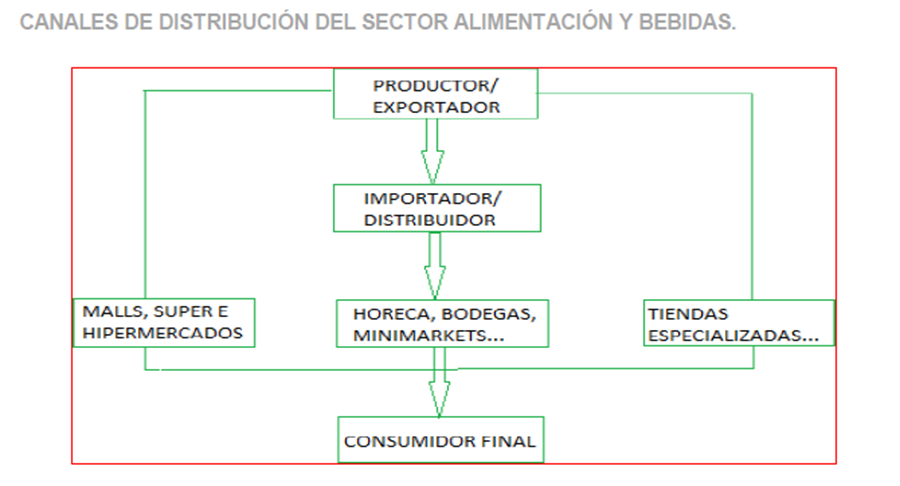
The report also highlights that Peru's food distribution system is short, with few intermediaries, and dominated by supermarket chains such as Cencosud and Falabella. Trade regulations also make entry relatively straightforward for European products, aiding competitiveness.
General profile of the agri-food sector
Peru's agri-food sector has grown notably, driven by demographic and socio-economic factors and rising purchasing power. The population, largely urban with 80% concentrated in Lima, has encouraged the development of distribution systems. Since 2010 there has been commercial expansion into the provinces, reflecting a shift in private consumption.
Consumption trends
In terms of trends, food spending remains a priority, accounting for 42.5% of household budgets. Even so, 2023 saw a decline in consumption of staples such as rice and vegetable oils. The trend towards healthier eating has boosted consumption. As for brands, international ones dominate the market, but local brands have gained ground with competitive prices.
Olive oil in Peru
The olive oil market has grown steadily in recent years, unlike other vegetable oils such as sunflower and soya, whose consumption has fallen. This growth is mainly due to olive oil being seen as a healthy product. Olive oil prices, especially in the extra virgin category, have risen because of factors such as production costs and rising demand. Peruvian consumers value olive oil for its health benefits and culinary versatility, which drives a preference for well-known, high-quality brands.
Peru's olive oil market is competitive, with both domestic and international brands present, although Spanish and Italian brands continue to dominate. Peruvian brands are gaining ground with quality products at competitive prices.
Olive oil in Peru is classified, according to demand, into virgin and extra virgin olive oils, obtained by mechanical or physical means. Packaging is mainly plastic and glass. Distribution channels include large supermarket chains such as Cencosud, Saga Falabella and Supermercados Peruanos, as well as convenience stores and online sales.
Trade balance
The trade balance between Spain and Peru in the oils sector, especially olive oil, shows sustained growth in Spanish exports to Peru. Between 2021 and 2023, Spanish olive oil exports reached €16,441.27 thousand, with extra virgin olive oil and other olive oils as the main products exported.
For Catalonia, between 2021 and 2023 there was a deficit in the fats and oils trade balance with Peru, with imports far exceeding exports and a negative balance of -€15,806.00 thousand.
Sales channels
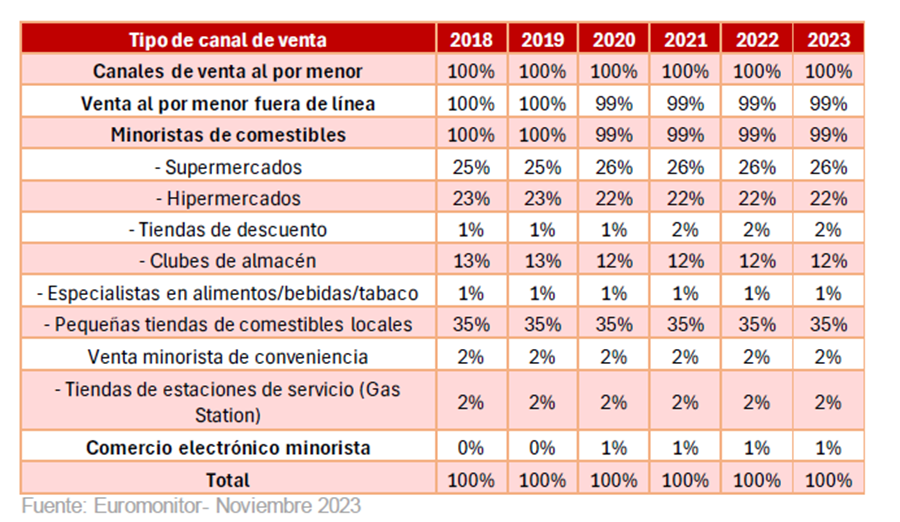
Peru's food and drink distribution channel is short, with few intermediaries between the importer and the end consumer. Retail has seen growing penetration of large stores and chains, driven by the development of shopping centres in Lima and the provinces.
The supermarket sector is dominated by three main groups: Intercorp/Supermercados Peruanos, Cencosud and Falabella, with more than 270 outlets between Lima and the provinces. Convenience stores such as Tambo+ and Oxxo have also expanded significantly and now supply 20% of the retail market.
Specialist shops such as Casa Gourmet and Selectos Ibéricos focus on gourmet, exclusive products, generally supplied through importers or by direct import.
Trade barriers
Peru applies an "open door" trade policy aimed at reducing economic and operational barriers to importing food products. European products generally face no tariff barriers, which aids the competitiveness of Spanish products, with national consumption tax of 16%, municipal tax of 2% and insurance of 1.25%.
As for non-tariff regulations, the Food Safety Act requires health authorisation, and the Labelling Act imposes detailed product information requirements, including warnings for foods high in sodium, sugar or fat.
If you would like to know about other commercial activities PRODECA runs in LATAM, you can write to Rosalba Arrufat at rarrufat@gencat.cat or to Laia Villabí at laiavillalbi@gencat.cat.