The canned fruit sector in Peru
Descarrega el document

Nota informativa - El sector de la fruita en conserva al Perú
09.17.24
Everything you need to know to export agri-food products to Peru
A course designed to give a clear understanding of the legal, cultural and logistical requirements for successfully starting to do business in Peru, a highly diverse market with great potential for agri-food products.
This report offers an analysis of the canned fruit industry in Peru, with the aim of identifying business opportunities for Catalan companies in that market. It begins with an overview of the country and a detailed profile of the agri-food sector. It then goes on to examine consumption trends and the trade balance, with particular emphasis on trade relations between Catalonia and Peru. It also sets out the various channels available for marketing this type of product in the Peruvian market, barriers to market entry and the industry's key players. It also includes information useful for companies preparing to pursue business opportunities, such as the country's business culture and relevant promotional activities.
According to the latest available information, in Peru's canned fruit sector most consumption is of imported products from countries such as Greece, South Africa, China and Indonesia.
The specific canned fruit sector, under tariff heading 2008, has grown exponentially over the past four years, as can be seen in import volume, where the category has grown by more than 25%.
The domestic market is highly concentrated in the hands of a few significant players, so commercial actions must be tightly focused on them. Operationally, the economic and legal barriers to importing these goods are fairly trade-friendly, although customs formalities can delay such operations owing to health requirements.
General profile of the agri-food sector
Peru has steady population growth, above the Latin American average, which, together with rising purchasing power and an expanding middle class, is driving domestic demand for agri-food products. The agri-food sector is one of the country's main economic drivers, with great potential in both the domestic and export markets. Climate and soil diversity, as well as abundant natural resources, are key factors favouring agricultural production.
Consumption trends
80% of Peru's population lives in urban areas, especially Lima, which has driven the development of distribution and supply systems. Since 2010 there has been growing interest in extending these systems to the provinces. Despite the pandemic, a year-on-year increase of 4.2% in citizens' purchasing power is forecast for 2019-2027. In 2022, 42.5% of household spending went on food.
Consumption of processed fruit
Processed fruit has kept prices stable, avoiding a significant drop in volume sales, although it competes with fresh produce in a market with low per-capita consumption of fruit and vegetables. Canned fruit consumption is seasonal and there is a trend towards healthier products, with innovations focused on reducing sugars and sodium, as well as using sustainable packaging.
Segmentation of the canned fruit market:
The most sought-after fruits include peach, pineapple, fruit cocktail, mango and maraschino cherries. Cans and glass jars are the main packaging formats. The main distribution chains are Cencosud, Saga Falabella and Supermercados Peruanos, which operate 322 supermarkets and hypermarkets. Canned fruit is popular both with families and in the food sector, especially in pastry-making and catering.
Attributes valued when buying:
Consumers value product availability in the shops they usually visit. Among different brands, they prioritise flavour, quality, nutritional value and price.
Competitive landscape - local competition:
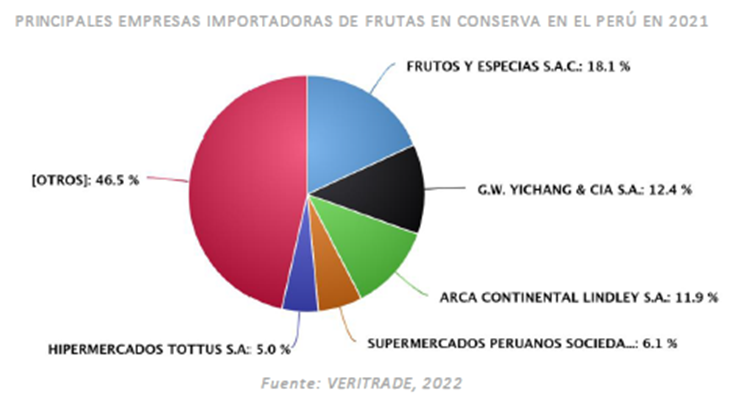
Peru's processed fruit market is fragmented, led by Frutos y Especias S.A.C. and GW Yichang & Cía, although together they do not reach 50% market share. The market is dominated by imported products, with several well-positioned local brands such as Arica, Valle Fértil and A1.
Trends in exports and imports (2021-2023):
Peru's agri-food exports grew, especially in fruit, with an increase of 18.19%. However, some subsectors, such as vegetables, showed a slight decline in 2023. Imports were volatile, falling in 2023 in categories such as cereals and fats/oils. Catalonia's exports to Peru have grown, notably in semi-manufactured goods and consumer manufactures.
Barriers to entry:
Peru maintains an open-door policy, removing tariff barriers for European products. The single-window system simplifies foreign trade formalities. There are, however, non-tariff barriers such as labelling regulations and the Food Safety Act. The Free Trade Agreement with the EU, in force since 2013, has enabled tariff-free exports of European products to Peru.
If you would like to know about other commercial activities PRODECA runs in LATAM, you can write to Rosalba Arrufat at rarrufat@gencat.cat or to Laia Villabí at laiavillalbi@gencat.cat.