


01.24.23
The 1st Olive Oil Business Forum brings together international buyers with 20 Catalan companies
Lleida hosts for the first time the business meeting Olive Oil Business Forum which will have the participation of eight buyers from four countries in Europe and Asia (Germany, United Kingdom, Japan and Taiwan) who will meet with twenty Catalan companies with the aim of pooling their interests and generating business flows.
L'Olive Oil Business Forum se celebra del 7 al 10 de novembre a la Llotja de Lleida i està organitzat per PRODECA, ACCIÓ i la Cambra de Comerç de Lleida. El programa ha inclòs, en la primera jornada, un tour oleoturístic amb els importadors i compradors internacionals a La Granadella (Les Garrigues), on han tingut l’oportunitat de visitar els camps d’oliveres, els establiments de les cooperatives de la zona i el Museu de l’Oli i el Centre de la Cultura de l'Oli, amb l’objectiu de conèixer de prop la cultura gastronòmica de l’oli.
Per la tarda, s'ha celebrat la benvinguda institucional per part de les autoritats, amb la intervenció de la responsable del sector de l’oli de Prodeca, Rosalba Arrufat, per presentar als compradors internacionals el potencial de Catalunya com a hub gastronòmic i agroalimentari, i que servirà de preludi a dues intenses jornades de trobades B2B entre importadors i empreses inscrites dels dies següents.
La segona i tercera jornada s'han organitzat les entrevistes B2B seguint una agenda preestablerta entre els empresaris catalans i els operadors internacionals. Per la tarda, els importadors tindran la possibilitat de visitar presencialment la seu d’algunes empreses productores.
The Olive Oil Business Forum is held from November 7 to 10 at the Llotja de Lleida and is organized by PRODECA, ACCIÓ and the Lleida Chamber of Commerce. The program included, on the first day, an oil tourism tour with international importers and buyers in La Granadella (Les Garrigues), where they had the opportunity to visit the olive fields, the establishments of the cooperatives in the area and the Oil Museum and the Oil Culture Center, with the aim of getting to know the gastronomic culture of oil.
In the afternoon, the institutional welcome was held by the authorities, with the intervention of Prodeca's head of the oil sector, Rosalba Arrufat, to present to international buyers the potential of Catalonia as a gastronomic and agri-food hub , and which will serve as a prelude to two intense days of B2B meetings between importers and registered companies in the following days.
On the second and third day, B2B interviews were organized following a pre-established agenda between Catalan entrepreneurs and international operators. In the afternoon, importers will have the opportunity to visit the headquarters of some production companies in person.

The participating Catalan companies:
- ACTELGRUP (Segrià)
- AGRICOLA SANT JOSEP COOPERATIVA (Tarragonès)
- DAULIBA (Pla d’Urgell)
- ETIM - COOPERATIVA FALSET MARÇÀ (Priorat)
- FRUITS DE PONENT - GRUP COOPERATIU (Segrià)
- GRUP PONS (Segrià)
- L’OLIVERA (Urgell)
- LES CABANES (Garrigues)
- MESTRAL – COOPERATIVA CAMBRILS (Baix Camp)
- NOSTRAT GOURMET (Segrià)
- OLI MIGJORN (Bages)
- OLICATESSEN (Garrigues)
- OLIS BELLAGUARDA (Garrigues)
- OLIS ESSENCIALS (Alt Empordà)
- OLIS SOLÉ (Baix Camp)
- OOVE DEGUSTUS (Garrigues)
- PRIORDEI (Priorat)
- TERRA LA VITA (Bages)
- TERRALL DE SANT ISIDRE (Garrigues)
Catalunya where olive oil is culture
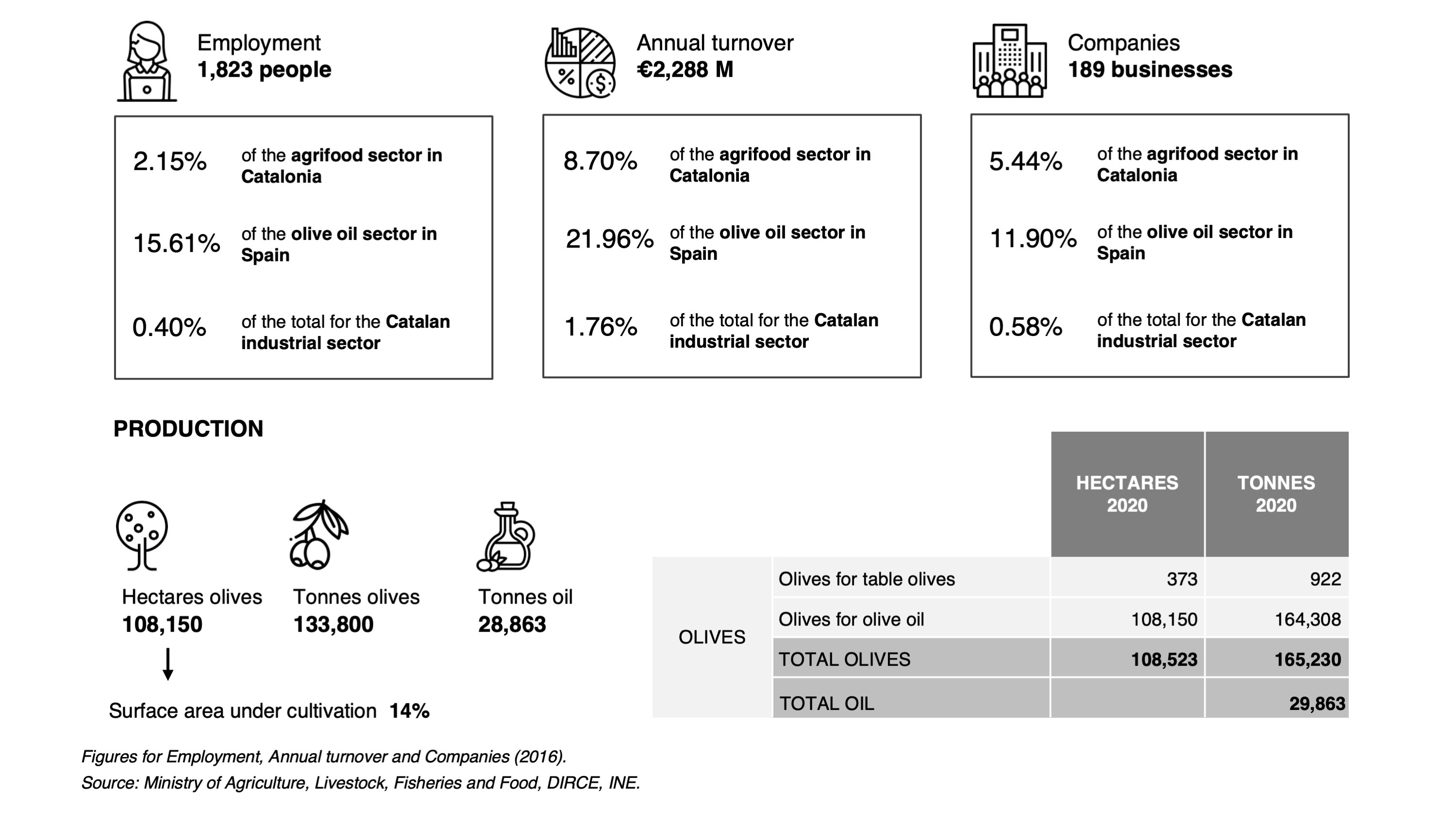
In Catalonia there are nearly 108,000 hectares of land dedicated to olive trees, 14% of the cultivated area, which provide the raw material, olives, for one of the industries with the most potential: processing, packaging and marketing of olive oil, with almost 2.87% of Catalonia's agri-food industry.
According to data from the mapping of the olive oil sector in Catalonia, carried out by Prodeca and ACCIÓ at the end of 2020, Catalonia currently has 347 olive oil producing companies that invoice 863 M€ in a grouped manner and they employ 1,459 workers. According to the report, the vast majority of Catalan companies dedicated to olive oil are SMEs (in 99% of cases). It is a consolidated sector, in which more than 60% have more than 10 years of experience and 25% are over 50 years old. By territory, 51% of these companies are concentrated in Tarragona (179), while in Lleida, which occupies the second position in terms of number of companies (89), 64% of turnover is concentrated there (554, €63m).
The olive oil sector, a sector with international projection
The study also highlights that 30% of companies in the sector export their products to other markets. In terms of exports, olive oil reached €368.21M in 2021, 2.86% of the total value of Catalan agri-food exports, with a 6.47% increase in value compared to 'previous year, and 110,918 tonnes, 12% less in relation to 2020, a fact that consolidates the path of the volume to the value of Catalan olive oil exports.
This growth trend has become evident in the first 8 months of 2022, in which olive oil sales in relation to the same period in 2021 have increased by 50% in value and a 21% by volume.
The main recipient countries of Catalan olive oil in 2021 have been Italy, Brazil, France, the United Kingdom and the United States, which account for more than half of Catalan sales of this product abroad.
Four potential markets for the sector are participating in the Olive Oil Business Forum, in which a growth in the value of olive oil consumption of 6.42% is expected in the next 5 years. In the case of Germany, Catalonia occupies a share of the olive oil market of close to 3%, where it competes mainly with Italy and Greece.
In terms of sales in the United Kingdom, Catalan oil occupies a market share of 8.50%. In the first year of Brexit, the olive oil sector grew by nearly 40% in value. The United Kingdom's departure from the EU implies certain changes, but in the case of olive oil, the Trade and Cooperation Agreement signed with the EU creates a free trade zone without quotas or tariffs.
In the last 10 years, Japan has steadily increased its import of olive oil (+183% in volume and +227% in value) and Catalonia has a market share of 2.64%. In line with this trend of growth in consumption, very competitively priced products from markets such as Turkey and Italy are entering Japan.
Taiwan has one of the highest per capita food expenditure rates in Northeast Asia, with relatively high incomes and a strong preference for gourmet products. Although the perception of Catalan oils has improved in recent years, most Taiwanese consumers still associate the product with Italy.

11.27.20
The olive oil sector in Catalonia: 347 companies, 1,500 workers and € 863M in annual turnover
Catalonia currently has 347 olive oil companies with a combined turnover of € 873 million and 1,459 employees. These data come from the report, prepared by ACCIÓ and Prodeca, that has been presented coinciding with World Olive Day.
30.11.20
Èxit de participació en primer Tast Guiat virtual d’Oli d’Oliva Verge Extra amb DOP catalanes
Commemorant el Dia Mundial de l’Olivera, el passat 27 de desembre Prodeca va organitzar el primer Tast Guiat virtual d’Oli d’Oliva Verge Extra amb la col·laboració de les cinc Denominacions d’Origen Protegida catalanes.