


South-East Asia: a bet on the present and future of the halal market
09.24.24
GULFOOD GREEN 2024
Prodeca - DACC is organising the participation of Catalan agri-food companies at GULFOOD GREEN 2024, under the slogan Catalonia where food is culture.
02.17.25
GULFOOD 2025
Prodeca is organising the participation of Catalan agri-food companies at the GULFOOD 2025 trade fair, under the slogan "Catalonia where food is culture".
The halal market is growing rapidly worldwide, opening up new opportunities for Catalan agri-food companies. According to Salam Gateway's latest "State of the Global Islamic Economy Report 2023/24", global consumption of halal products reached USD 2.29 trillion in 2022 and is expected to hit USD 3.1 trillion by 2027. This growth is mainly due to a young, expanding Muslim population of more than 2 billion consumers worldwide.
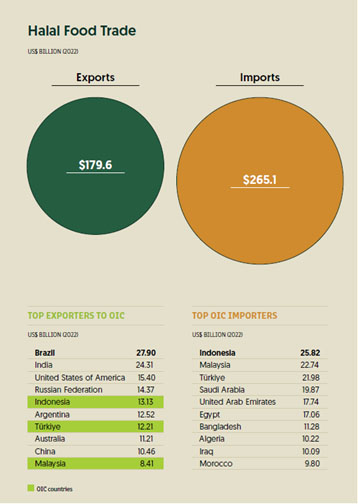 |
Growth of the halal food market
Muslim consumers' food spending also rose by 9.6% in 2022, reaching USD 1.4 trillion, compared with USD 1.28 trillion the previous year. Projections suggest this figure could reach USD 1.89 trillion by 2027, with a compound annual growth rate (CAGR) of 6.1%. The OIC is the organisation of Islamic countries, with 57 members, making it the organisation with the most member countries after the UN.
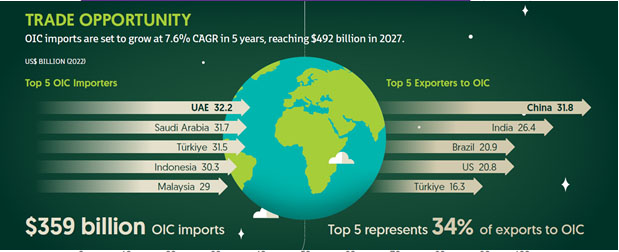
Furthermore, Muslim-majority countries have a large import balance, either because of their geographical situation, which means a high proportion of agri-food imports, or because their agri-food sector is underdeveloped. On this point, when we look at which countries import the most and which export the most to halal markets, Europe does not feature prominently, which opens an opportunity to build a growing market share.
South-East Asia: a bet on the future
The halal market in South-East Asia (SEA) offers a huge opportunity for Catalan food companies. With a young, fast-growing Muslim population, rising demand for halal products and developing infrastructure, this market offers various opportunities for companies looking to expand internationally. In this article we explore the growth of the halal market, the demographic, technological and strategic opportunities for Catalan companies, and offer key recommendations for succeeding in this sector.
Demographics and consumption opportunities
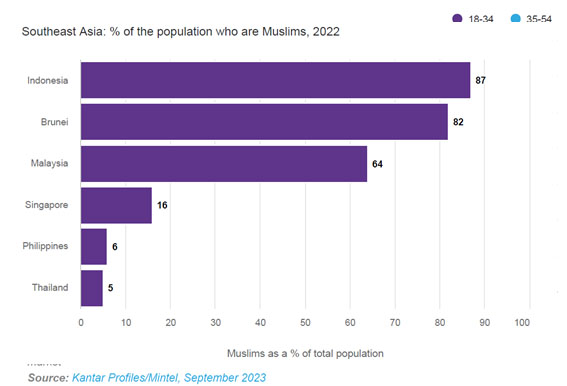
South-East Asia, with countries such as Indonesia, Malaysia, Singapore and Thailand, is home to a large Muslim population. Indonesia, for example, is the country with the world's largest Muslim population, with more than 230 million Muslims, around 87% of its total population. These demographics point to a potentially large and diverse market for halal food products.
Chart 1: Percentage of the Muslim population in SEA countries.
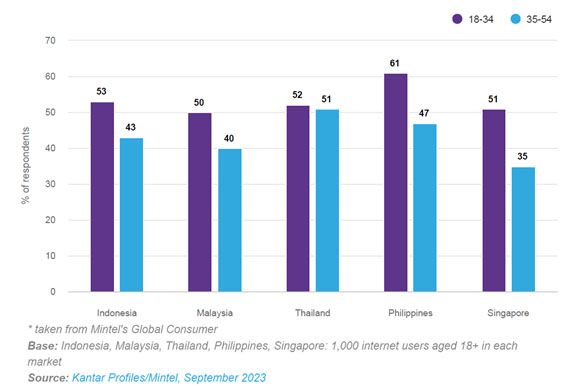
What's more, young consumers in South-East Asia are especially open to trying new flavours and foods. This market segment represents a major opportunity for Catalan companies offering innovative, high-quality products.
Chart 2: Percentage of consumers looking for new foods to try
Opportunities in food technology
The climate crisis and supply chain disruptions have made food security a priority in halal markets. Investment in alternatives from countries with advanced food technology is a key growth area. Catalan companies can take advantage of this trend by investing in technological innovations that can be adapted to these markets' specific needs, and by positioning themselves as an option for importers looking for European quality and reliable supply.
The positioning of Catalan products, an opportunity abroad
European products, and Catalan ones in particular, have an image of quality and reliability among Muslim consumers. This positive perception stems from high quality, food safety and strict compliance with production standards. As a result, Catalan products are well received in South-East Asia's halal markets, where consumers value high standards and transparency in food production.
Furthermore, many Catalan companies are already halal certified, owing to local and European demand for some of their products. Accredited halal certification gives access to a market where it is mandatory in many Muslim-majority countries such as Indonesia, the United Arab Emirates and Saudi Arabia, among others. It is also worth noting that not all halal certifications are equally valid in every country, as each country has its own local requirements. It is advisable to choose a certification body that holds all the accreditations needed for the countries you want to enter.
Extending the possibilities with halal drinks
Fermented drinks such as kombucha, and alcohol-free alternatives to wines and spirits, are gaining popularity worldwide. If halal certified, these products can meet the growing demand for healthy, innovative drinks among Muslim consumers in SEA. Catalan companies can explore creating halal kombucha or alcohol-free alternatives to wines and spirits, making sure they comply with halal rules from the production process through to the ingredients used. JAKIM, Malaysia's competent authority for halal product certification, recently certified a fermented kombucha with naturally occurring alcohol, but at less than 0.5%.
Case study: Malaysia

Malaysia is one of the world leaders in the Islamic economy, having held first place in the Global Islamic Economy Indicator for ten consecutive years. The country has introduced various national policies to encourage growth in the halal market, making it an attractive market for companies looking to enter this sector.
They also Malaysia has also been organising, for many years, the MIHAS (Malaysia International Halal Showcase) , a leading event promoting the halal industry worldwide. Since its creation in 2004 it has become a key platform for local and foreign companies to thrive in halal trade. The 2024 edition will take place from 17 to 20 September at the Malaysia International Trade and Exhibition Centre (MITEC) in Kuala Lumpur, and is expected to be the largest yet, with more than 2,000 exhibition stands from 45 countries and over 40,000 trade visitors (Mihas). The fair is an excellent opportunity to explore the South-East Asian and global halal market, offering a solid platform for innovation, business growth and international collaboration.
Strategies for entering the SEA halal market
- Adapting products and messaging: Make sure your products not only comply with halal regulations but are also adapted to local tastes and rules. Adjust product flavours and use local-language messaging that resonates with local consumers' values.
- Information and awareness: Highlight halal certification and other valuable certifications on your products. Use digital marketing platforms and social media to increase consumer confidence in halal-certified products.
- Strategic partnerships: Set up partnerships with local companies to better understand the market and make use of existing distribution networks. Working with a trusted local importer can help you build trust and brand loyalty.
South-East Asia's halal market is expanding and offers numerous opportunities for Catalan agri-food companies. With a young population open to trying new and different things, and growing demand for halal products, this market is ripe for exploration. Catalan companies can seize this opportunity by adapting their products and marketing strategies to comply with halal regulations and the cultural preferences of Muslim consumers in South-East Asia.
So, halal certification not only opens doors to new markets but also allows Catalan companies to contribute to culinary diversity. Holding accredited certification is essential for building long-term relationships of trust.
Catalan companies can always count on Prodeca for advice when they want to know more about foreign markets in the agri-food sector. Prodeca has a diverse, highly skilled team with knowledge and expertise across multiple areas.
For the halal market specifically, we have recently been joined by Kamel Jalloul, an expert in international halal markets and regulations. His experience and in-depth knowledge of this sector's dynamics and rules strengthen our ability to offer first-rate advice to companies wishing to explore and expand in the global halal market.
If you would like to know about other commercial activities we run in sub-Saharan Africa, you can write to Susanna Barquin at sbarquin@gencat.cat or to Kamel Jalloul at kameljalloul@gencat.cat.

12.09.19
Catalonia boosts its presence on halal markets with top-quality products
The value of Catalan agri-food exports has risen sharply in that part of the world due to the increasing penetration of products such as meat, fruit and vegetables, cereals, coffee, tea, spices, fish, patisserie products, and beverages.

07.09.21
The digital impact on the halal consumer segment
Javier Albarracín, of Barcelona Halal Services, writes about the massive use of the internet to promote and raise the profile of Muslim friendly brands aimed at Muslim consumers, which is growing exponentially on several fronts.