02.18.25
The Catalan agri-food sector reaches a new historic milestone in international trade
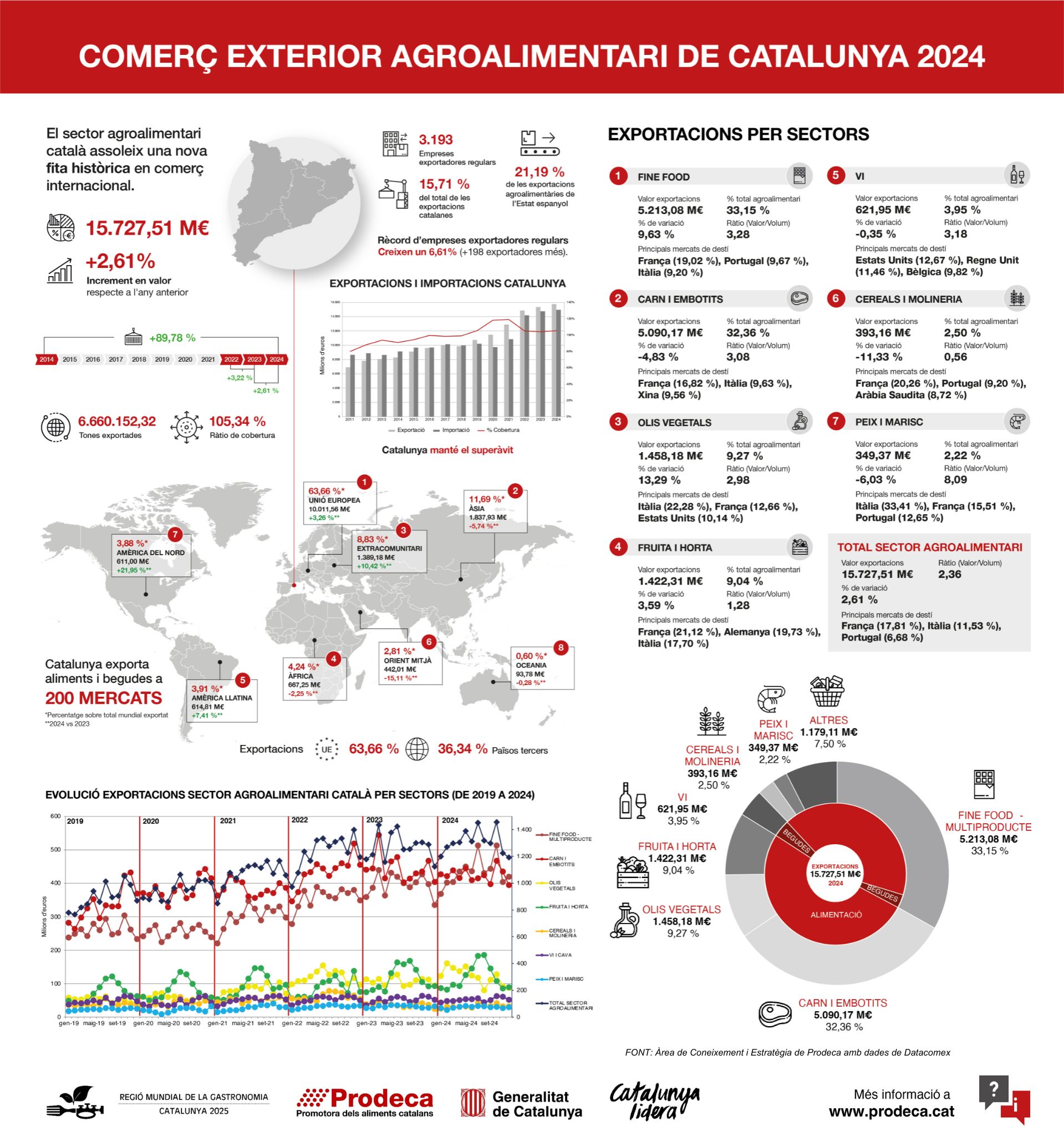
The Catalan agri-food sector has set a new record in international trade, reaching €15,727M in 2024 and up 2.61% in value on the previous year. This growth consolidates Catalonia as a key player in international markets, highlighting its ability to compete successfully in an increasingly demanding global context.
The results demonstrate the commitment of Catalan companies to a strategy based on adding value to the product rather than volume. Over the past 10 years Catalan agri-food exports have grown 90% in value and 16% in volume, showing improved competitiveness and the sector's ability to adapt to new demands from international consumers.
The Minister for Agriculture, Livestock, Fisheries and Food, Òscar Ordeig said at the press conference that "the agri-food sector remains one of the fundamental pillars of the Catalan economy and today a third of the sector's turnover comes from exports, which underlines its strategic importance for the country's economy."
Overseas sales of Catalan food have also strengthened the global competitiveness of the Catalan economy, consolidating it as one of the drivers of international growth. Catalonia's agri-food exports are growing three points above the average for Catalan exports as a whole, contributing decisively to its consolidation as the territory's leading economic sector.
Catalonia thus consolidates its weight in Spanish foreign trade. Catalan agri-food exports account for almost one in every four euros (21.19%) of Spain's total exports.
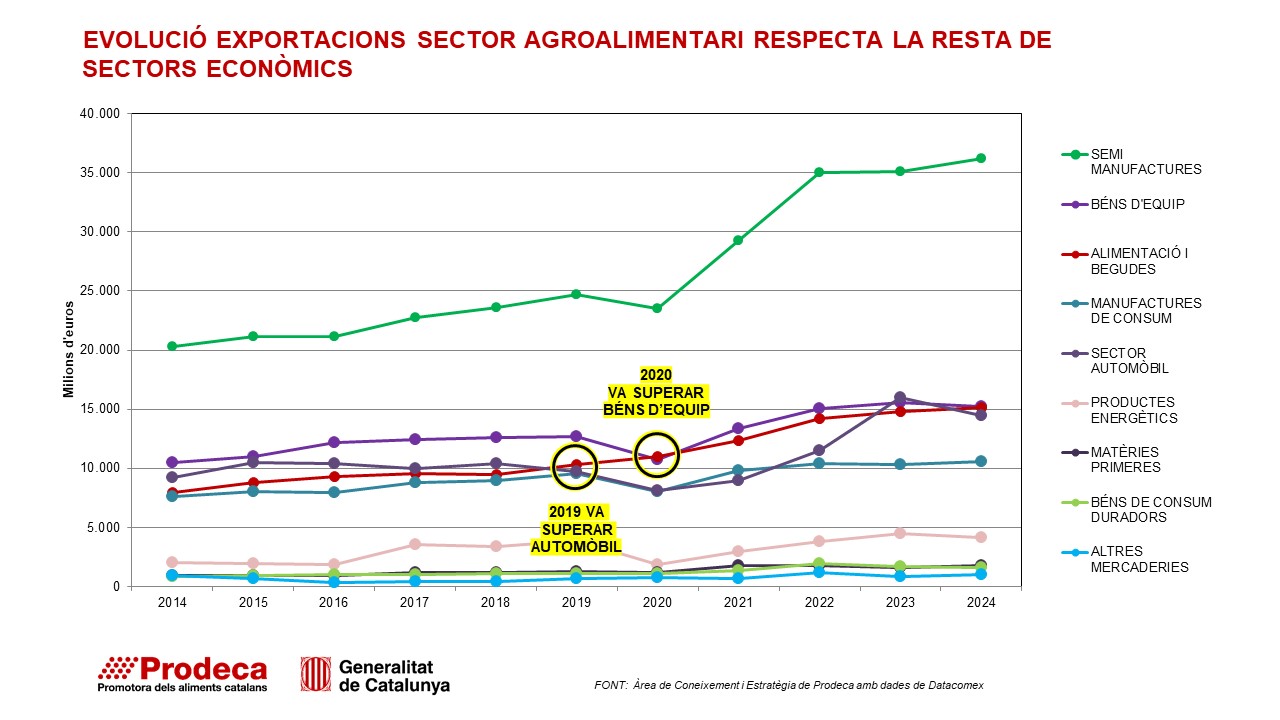
In addition, agri-food remains the third-largest exporting economic sector behind semi-manufactured goods and capital goods , narrowing the gap to just €108M. One in every seven euros Catalonia exports comes from Catalan agri-food (15.71%).
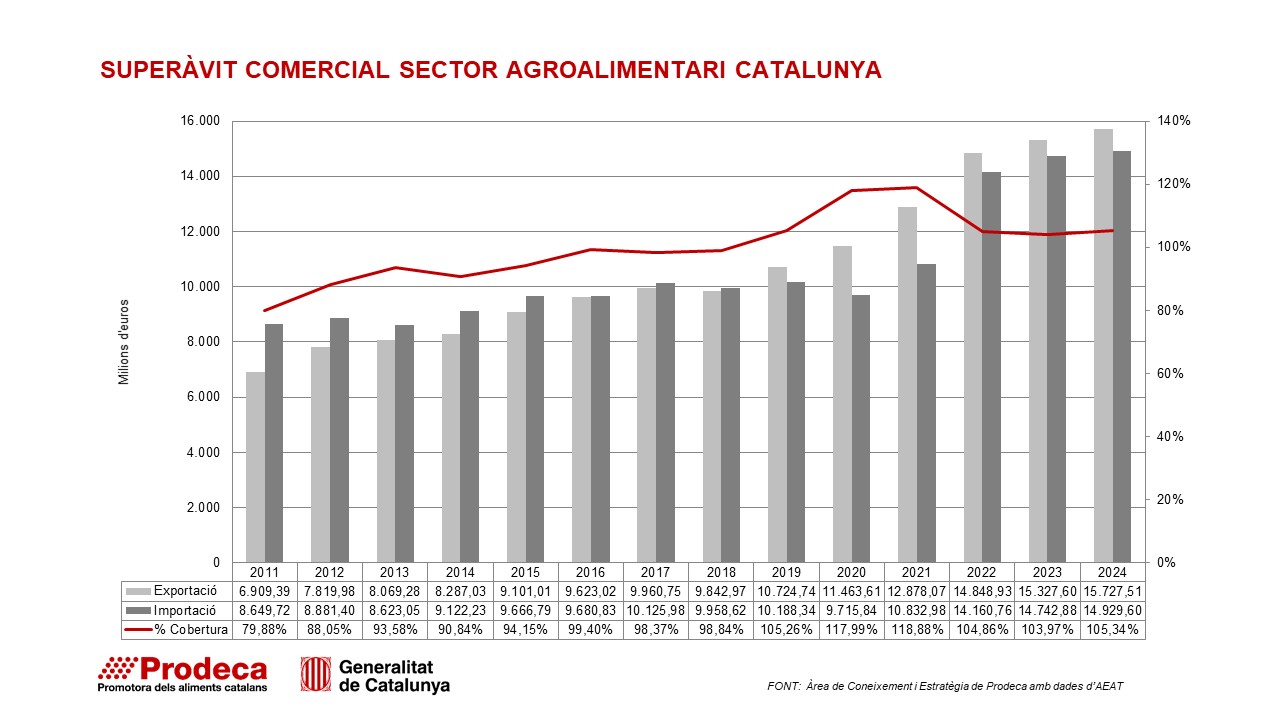
As for the trade surplus, Catalonia maintained it with a coverage ratio of 105% in 2024. This indicator shows the sector's strength, its ability to generate added value and the growing international competitiveness of Catalan companies.
Record number of regular exporters
In 2024 a new record was set for the number of regular exporters, reaching a total of 3,193 companies, an increase of 198 companies on the previous year (+6.6% compared with 2023).
Of these companies, more than 80% are SMEs, contributing 11% of total Catalan exports. Catalonia also remains a key driver in this area, as one in four of Spain's agri-food exporting companies is Catalan (27.5%).
In the words of Prodeca's managing director, Dèlia Perpiñà, "this rise in the number of exporting companies reflects not only greater export capacity but also continued growth among regular exporters. They have found in exporting a way to drive their growth, resilience, dynamism and competitiveness".
Agri-food exports by subsector
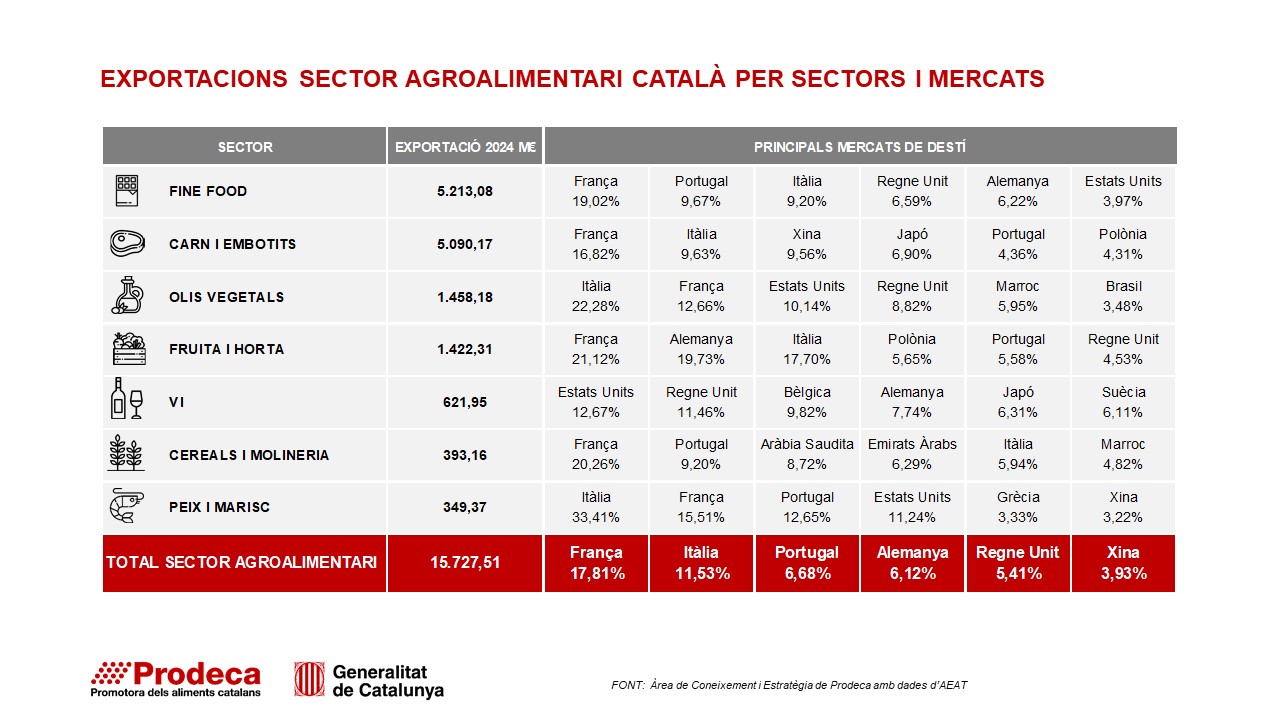
The fine food sector is the leading exporting sector by value, accounting for more than 33% of total exports. This growth is due to rising international demand for high-quality products such as sweets, cocoa, coffee, infusions, snacks and ready meals. The sector performed very well in all markets, especially European (+10.85%), Asian (+11.35%) and North American (+9.32%). It fell only slightly in the Middle East and Oceania. These figures confirm the consolidation of Catalonia as a supplier of gourmet products.
The meat sector, although still the largest sector by volume, saw a -4.83% adjustment in value. Falling pork sales to China (-26.18%) had a notable impact, while beef rose sharply (+32.17%) thanks to the recovery of the Algerian market, where €49.46M was sold in 2024, and rising demand in European markets such as Portugal (+15.80%) and Italy (+6.79%).
Vegetable oils grew by more than 13% in value, with notable growth in olive oil exports to the United States (+104.19%), Italy (+60.42%) and Japan (+40%). These figures reflect a clear trend towards adding value to the product, driven by demand from markets that favour quality oils.
The fruit and vegetables sector performed well, up 3.6% in value and 5.76% in volume. Fruit exports grew particularly strongly in Portugal (+40.06%) and the United Kingdom (+18.63%), while falling in markets such as Italy (-12.64%).
The wine and sparkling wine sector fell slightly by -0.35% in value but managed to add value to the product thanks to a 10.96% rise in the average price per litre. Growth stands out in markets such as the United States (+10.44%) and Canada (+7.36%), while sales contracted in Germany (-36.51%) and Switzerland (-17.82%).
Sparkling wines consolidate their role as the wine sector's driver , with 62.38% of the sector's value and 63.31% of its volume. They grew 2.56% in value alongside an -8.52% fall in volume. The average price of Catalan sparkling wines is growing more than a point above the average for the wine and sparkling wine sector as a whole (+12.12%).
Cava, for its part, accounts for more than 83% of sparkling wines (in both value and volume), with more than 52% of exported value and volume. It fell a modest -0.43% in value alongside -13.91% in volume, producing a considerable increase in the ratio (+15.67%). Among the countries buying Catalan cava, growth stands out in the Netherlands (+47.12%), Sweden (+13.62%), Japan (13.57%), the United Kingdom (+10.48%) and the United States (+8.10%). It fell significantly in Germany (-56.32%).
As for still wine , it accounts for 35.73% of total value and fell -14.52% in volume and -5.72% in value. The best-performing destination markets are the United States (+6.18%), Canada (+4.40%) and the Netherlands (+15.64%). There were falls in Germany (-31.63%), Switzerland (-23.55%) and Japan (-9.98%).
The cereals and milling sector fell in both volume (-11.32%) and value (-1.09%) because of lower global demand and growing competition in this segment.
Fish and shellfish fell -6.03% in value despite a 2.72% rise in volume. Exports grew in markets such as Portugal (+19.22%) and the United States (+22.50%), while falling significantly in Italy (-24.73%) and France (-11.92%).

A focus on stable markets
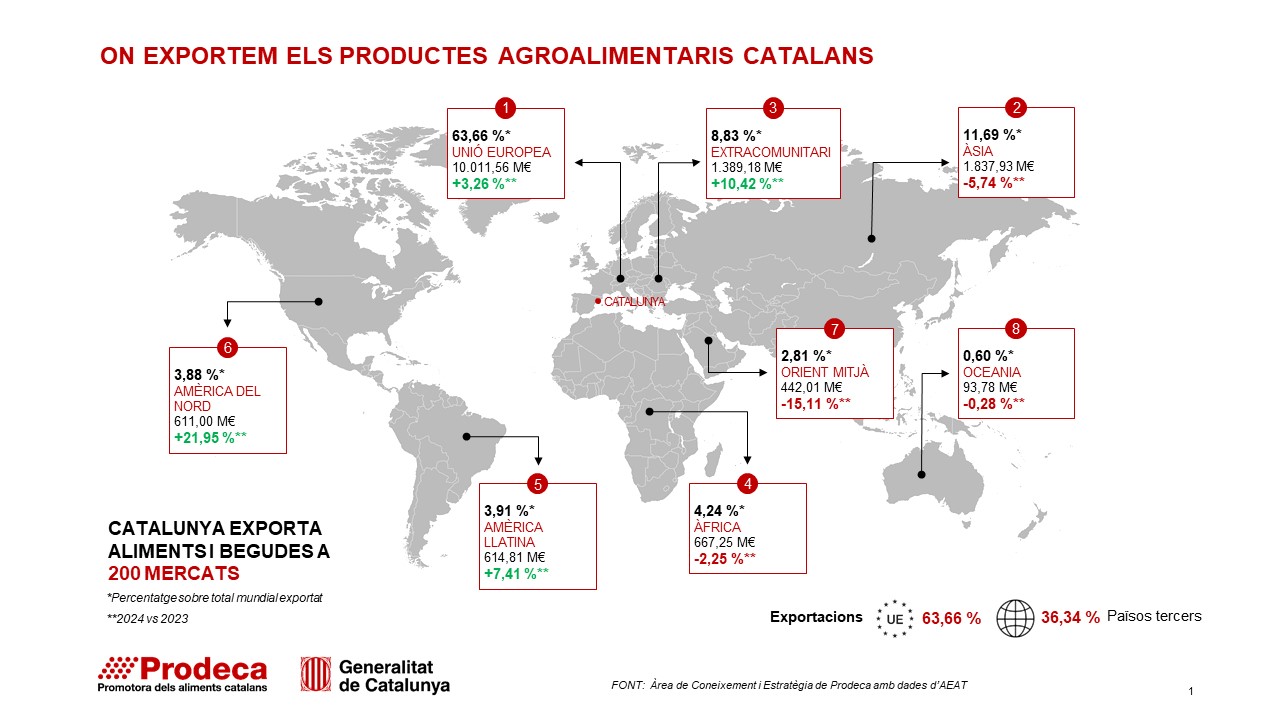
Catalonia exports agri-food products to 200 countries, with notable growth in the European market, which has consolidated its position as one of the preferred destinations for Catalan exports.
This trend began in 2023 with the increase in the share of exports to the European Union, which now account for 63.66% of the total, a significant increase on 55.85% in 2022. The Catalan agri-food sector has thus chosen to increase its presence in more stable, closer markets such as Europe, adapting to socio-economic and geopolitical change.
Outside the European market, growth stands out in North America (+22%), Latin America (+7.41%) and non-EU Europe (+10.42%), showing the sector's ability to expand into new strategic territories.