


05.08.26
Catalonia's organic segment consolidates its economic weight with more than 5,180 operators
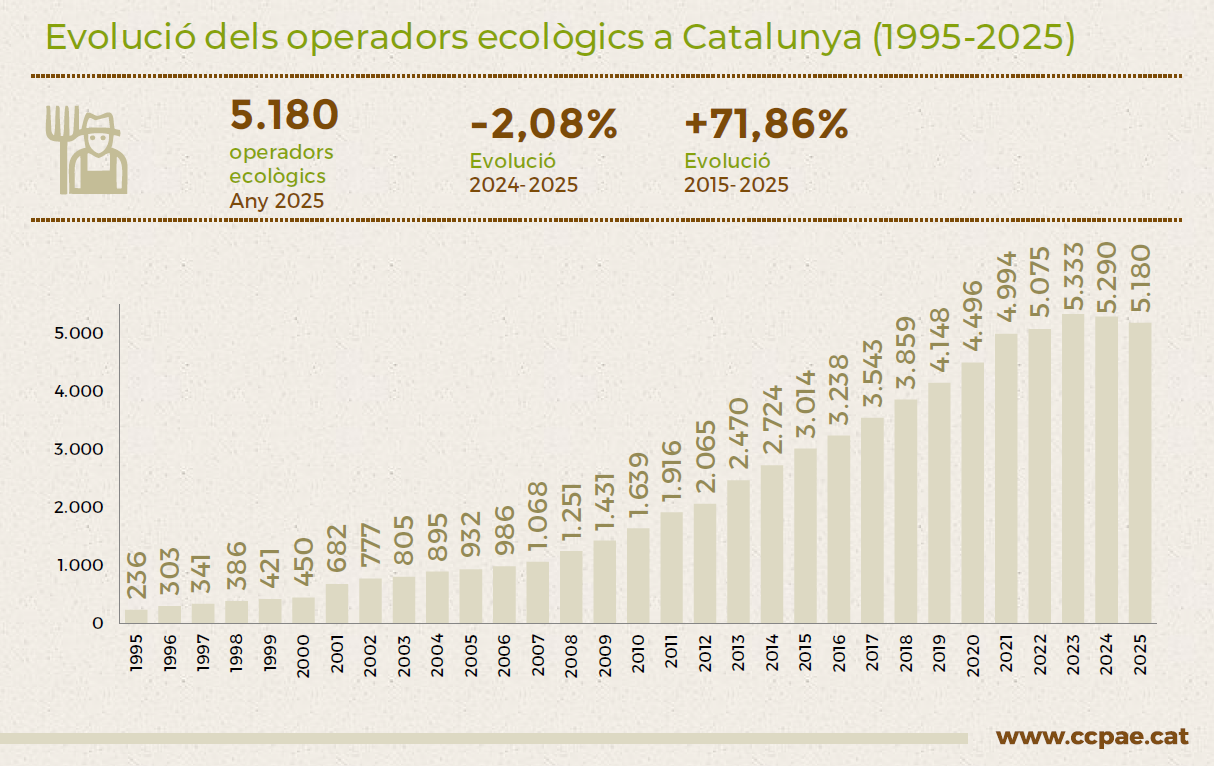
The 2025 figures presented by the Catalan Council for Organic Agricultural Production (CCPAE) confirm the maturity of the Catalan organic segment. Despite a slight adjustment in the number of operators, the agri-industrial segment and marketing are consolidating as the economic drivers of a sector with 5,180 operators and 287,266 hectares.
Catalonia reaffirms its position as southern Europe's leading hub for organic agri-food products. According to the CCPAE's annual report for 2025, the sector has entered a consolidation phase in which, beyond the area under cultivation, attention is shifting towards the industry's processing capacity and the strength of its business base.
With a total of 5,180 registered operators at the close of 2025, the sector shows a moderate decline of 2.08% on the previous year. However, this figure should be read in a context of structural growth: over the past decade (2015-2025), the number of organic operators in Catalonia has grown by around 72%. This trend shows that organic production and processing has become a fundamental and stable pillar of Catalan agri-industry.
Agri-industry: a driver of added value
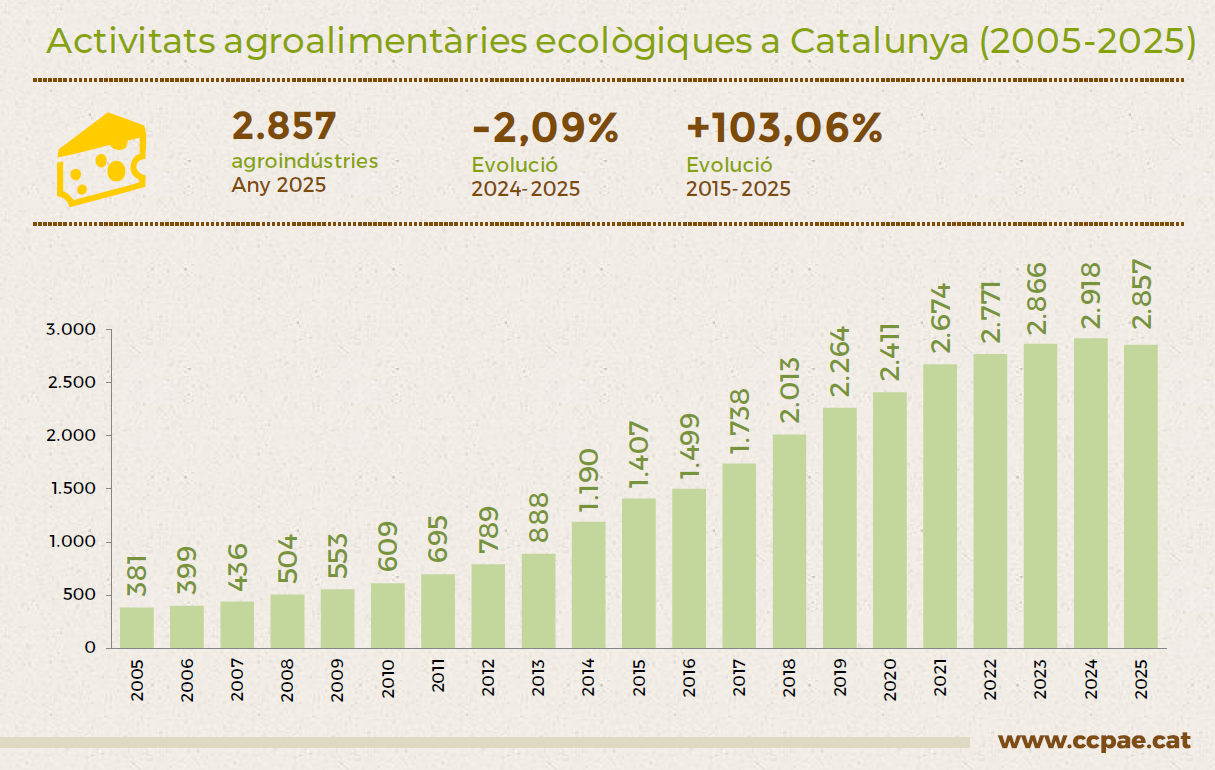
From a business perspective, the most significant finding in the report is the resilience of the agri-industrial segment. Catalonia has 2,857 organic agri-food activities. Although the total number of agri-industries fell slightly over the past year, the longer view still shows strong growth, up 103% since 2015.
The sector's business structure stands out for its strong capacity to generate added value. At present, 23% of operators are processors (1,507 companies), while 11.3% are engaged in marketing (742 companies). This concentration in the final stages of the value chain is what allows Catalonia to lead not only in volume but in economic strength.
The segment's main agri-food activities are:
- Marketing and distribution: With 645 companies, it accounts for 23% of industrial activity.
- Wines, cavas and sparkling wines: One of the most dynamic subsectors, with 427 producing and bottling companies, up 152.6% over the past decade.
- Storage: With 377 operators, it reflects the sector's logistical complexity and service capacity.
Regional strength and oversight
The regional breakdown shows a balanced Catalonia. Barcelona remains the nerve centre for processing and distribution, while Lleida and Tarragona maintain a very strong production base clearly geared towards foreign markets, especially in the fruit, olive oil and wine sectors (vineyards, with 33,794 ha, remain the dominant crop).
For business, legal certainty is a critical asset. The CCPAE stepped up its oversight work during 2025, handling 5,046 monitoring files and carrying out 482 analyses. Certification activity was also intense, with 9,548 certificates issued, 1,834 of them specifically for export, ensuring that the Catalan “eco” label remains an international quality passport.
Conclusions and challenges
The CCPAE's 2025 report describes a sector that has moved beyond its initial phase. Although growth in the number of operators has levelled off, companies are larger and more professional.
The future challenge, in line with Prodeca's strategy, will be to keep increasing domestic consumption and consolidate penetration in high-value international markets. The Catalan organic industry is not just a sustainable production option; it is a strategic business segment, highly technical and with an export capacity that places it at the forefront of the country's agri-food system. Catalonia has the land, the processing industry and the commercial expertise to continue leading this market.

05.15.24
Organic farming in Catalonia sets new record highs again
This week the CCPAE presented its 2023 report on organic farming in Catalonia, showing an increase in both farmed area and operators on last year. Turnover (2022) grew by close to 9% (€1.294 billion) on the previous year and has multiplied

09.14.23
Catalonia, leader of southern Europe's organic sector
Catalonia is the largest organic products market in Spain and southern Europe, with a market worth more than €1,190 million. Catalan organic companies will show their commercial reach internationally at the next Biofach, with Prodeca.
